1Marketing is proud to accompany enterprises in architecting comprehensive cloud strategies and deploying high-performance Google Cloud solutions. With extensive implementation experience across diverse industries, our engineers empower organizations to leverage the Google Cloud ecosystem, harnessing artificial intelligence, big data analytics, and serverless architectures. 1Marketing serves as your trusted strategic partner in turning digital transformation visions into measurable commercial reality.
Definition and Strategic Role of Google Cloud

What is Google Cloud? Fundamentally, it is an integrated suite of cloud computing services that enables enterprises to build, deploy, optimize, and scale web applications and backend infrastructure with elastic flexibility. Operating across Infrastructure as a Service (IaaS) and Platform as a Service (PaaS), Google Cloud provides global enterprises with resilient infrastructure, machine learning toolkits, data warehousing, and digital asset governance.
The primary mission of Google Cloud is to supply an ultra-secure, stable, and highly scalable environment that minimizes operational expenditure, accelerates digital product velocity, and safeguards confidential consumer information. By migrating workloads to Google Cloud, companies liberate internal engineering resources from managing physical on-premise hardware, focusing instead on core commercial differentiation. In an era marked by rapid market disruption, cloud agility is not an elective upgrade—it is the bedrock of business continuity. Partnering with 1Marketing gives your organization a clear, low-risk roadmap to transform Google Cloud into an enduring competitive moat.
Core Architectural Components of Google Cloud
- Google Cloud Platform (GCP): The flagship suite of modular cloud computing services encompassing Compute Engine (virtual machines), Google Kubernetes Engine (GKE container orchestration), Cloud Storage (elastic object storage), BigQuery (multi-cloud analytics data warehouse), along with identity, security, and networking modules.
- Google Workspace: A unified suite of cloud-native productivity and collaboration tools—including Gmail, Drive, Docs, Sheets, and Meet—enabling high-velocity collaboration across distributed enterprise teams.
- Enterprise AI & Machine Learning APIs: Cutting-edge artificial intelligence toolkits and pre-trained models—including Vertex AI, Speech-to-Text, and Cloud Vision—allowing development teams to integrate generative AI and predictive intelligence into customer touchpoints.
Understanding these discrete components allows leadership teams to align deployment models with exact financial budgets, performance thresholds, and industry compliance frameworks. For complex workloads, Google Cloud delivers continuous automated patching, zero-trust perimeter security, and global interconnectivity.
Vision and Mission of Google Cloud in the Digital Era
Google Cloud’s strategic vision is centered on democratizing enterprise-grade computing power, granting organizations of all scales—from nimble tech startups to multinational conglomerates—seamless access to advanced AI algorithms, massive parallel processing, and automated DevOps infrastructure at predictable costs. The platform emphasizes open cloud standards, avoiding vendor lock-in through Kubernetes and multi-cloud compatibility, while maintaining the industry's cleanest, carbon-neutral cloud infrastructure.
Target Audiences and Well-Suited Industries
- Small and Medium Enterprises (SMEs): Seeking to eliminate capital-heavy on-premise server investments and shorten software delivery cycles.
- Digital Transformation Leaders: Organizations consolidating siloed big data lakes and activating predictive customer analytics with our Data Analytics solutions.
- Regulated Sectors: Financial services, healthcare, pharmaceuticals, and fintech requiring strict zero-trust data sovereignty, audit trail transparency, and regulatory compliance.
- High-Velocity Engineering Teams: Companies modernizing microservices architectures, building automated CI/CD pipelines, and requiring auto-scaling compute capacity.
Core Business Benefits of Google Cloud for Modern Enterprises
Adopting Google Cloud delivers tangible, compounding competitive advantages across several operational tiers:
1. Cost Optimization and Operational Agility
Transitioning from traditional on-premise data centers to Google Cloud eliminates depreciating hardware purchases, server room cooling costs, and dedicated maintenance overhead. Google Cloud’s per-second billing, committed-use discounts, and automated resource rightsizing ensure enterprises pay strictly for active compute capacity, routinely reducing infrastructure bills by 25% to 40%.
2. Elastic Scalability and High Availability
Google Cloud’s global private fiber-optic network delivers virtually limitless horizontal and vertical scaling. Applications effortlessly absorb millions of unexpected traffic spikes without latency bottlenecks or sudden service outages, backed by automated global load balancing and 99.99% service level agreements (SLAs).
3. World-Class Security and Global Compliance
Google implements a multi-layered security model built from custom-designed server boards to cryptographic data verification at rest and in transit. Granular Identity and Access Management (IAM), automated Security Command Center audits, and compliance certifications (ISO/IEC 27001, SOC 2, HIPAA, GDPR) safeguard mission-critical data assets against sophisticated cyber threats.
4. Data Innovation and Competitive Advantage
By connecting raw operational records directly into BigQuery and machine learning pipelines, organizations transition from historical reporting to predictive decision-making. Integrated development environments and serverless execution models (such as Cloud Run and Cloud Functions) enable developers to bring novel digital features to market in days rather than months.
5-Step Optimal Google Cloud Deployment Framework by 1Marketing
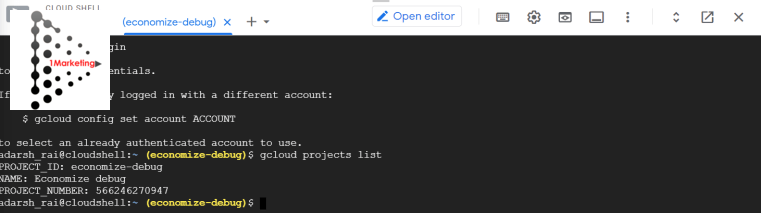
Migrating enterprise workloads demands structured governance. Below is the battle-tested 5-phase migration framework engineered by 1Marketing:
Step 1: Strategic Discovery and Migration Planning
Conducting an exhaustive audit of legacy infrastructure, mapping software dependencies, quantifying Total Cost of Ownership (TCO), and defining measurable business KPIs. Formulating a customized migration roadmap categorized by workload priority.
Step 2: Secure Environment Configuration & Foundation Setup
Setting up Google Cloud Organization hierarchy, provisioning Virtual Private Cloud (VPC) subnets, configuring granular IAM roles, implementing least-privilege security policies, and establishing centralized billing controls.
Step 3: Systematic Data and Application Migration
Selecting appropriate migration pathways—whether Rehosting (Lift and Shift), Replatforming, or complete Cloud-Native Refactoring. Leveraging Google Cloud migration utilities (Database Migration Service, Migrate for Compute Engine) to guarantee zero operational downtime.
Step 4: Continuous Performance Profiling and Cost Governance
Implementing Cloud Monitoring and centralized logging dashboards. Establishing automated budget alert notifications, rightsizing underutilized virtual machines, and optimizing BigQuery partition schemas to maintain peak performance at minimal cost.
Step 5: Enterprise Training, Operational Handover & Managed Support
Delivering comprehensive standard operating procedure (SOP) documentation and team upskilling sessions. Providing ongoing 24/7 managed cloud monitoring to ensure infrastructure stability, automated backups, and disaster recovery readiness.
Common Google Cloud Deployment Pitfalls and Solutions

- Uncontrolled Cloud Spend Spikes: Caused by unmonitored development VMs and improper storage tiers. Solution: Enforce automated budget kill-switches, lifecycle storage rules, and weekly cost allocation audits.
- Permissive Security & IAM Vulnerabilities: Assigning broad administrative privileges across teams. Solution: Implement strict Role-Based Access Control (RBAC), multi-factor authentication (MFA), and automated IAM anomaly detection.
- Sub-Optimal Query Architecture in BigQuery: Running unindexed, unpartitioned queries across petabyte tables. Solution: Enforce clustering and date-partitioning strategies to slash compute costs by up to 90%.
- Lack of Internal Staff Enablement: Resistance from traditional IT teams unfamiliar with cloud primitives. Solution: Partnering with certified cloud implementation consultants to guide internal engineering teams through hands-on deployment.
Client Success Story: Enterprise Omnichannel Retail Transformation
Background
A major omnichannel retail enterprise with over 40 retail locations and high-traffic e-commerce operations faced severe system bottlenecks during seasonal sales campaigns. Their legacy on-premise servers regularly crashed under high concurrency, causing lost revenue, checkout errors, and delayed order fulfillment.
1Marketing's Engineering Solution
- Architected a multi-region hybrid GCP topology, deploying microservices on auto-scaling Google Kubernetes Engine (GKE) clusters.
- Migrated high-load transactional databases to Cloud SQL with read replicas and automated failover mechanics.
- Consolidated customer purchasing data into BigQuery, enabling real-time inventory tracking and dynamic pricing models.
- Configured Cloud CDN and Cloud Armor to protect against distributed denial-of-service (DDoS) threats and accelerate global asset delivery.
Measurable Outcomes
- Maintained 99.99% system uptime throughout peak Black Friday shopping surges with zero checkout interruptions.
- Reduced total IT infrastructure and maintenance operational costs by 35% year-over-year.
- Accelerated mobile application API response times by 58%, driving a significant lift in checkout conversion rates.
Frequently Asked Questions About Google Cloud (FAQ)

Conclusion: Partnering with 1Marketing for Cloud Excellence

Google Cloud is a robust technological foundation that unlocks operational agility, enterprise scalability, and AI-driven innovation. Navigating cloud adoption effectively demands deep architectural expertise, structured migration governance, and continuous financial oversight. With extensive field experience, 1Marketing is committed to delivering tailored cloud solutions that protect your balance sheet while accelerating business growth.
Ready to modernize your infrastructure? Contact 1Marketing today to schedule a complimentary technical audit and tailored migration roadmap with our senior cloud architects:
- Website: 1m.io.vn
- Email: [email protected]
- Hotline: (+84) 3 6669 6662