Figure 1: Gemini 4 Argon platform model officially announced and deployed globally by Google DeepMind (Image copyright: 1Marketing).
Unlike conventional model upgrades that only focus on increasing scores on academic language tests, Gemini 4 Argon is positioned as the pioneering model to open the Gemini 4 generation. This is a Frontier Reasoning Model system specifically designed to handle long-horizon autonomous tasks (Long-horizon Autonomous Tasks), large-scale software restructuring, advanced cybersecurity defense and the operation of autonomous agent ecosystems (Agentic AI).
For business leaders, CTOs and teams of digital marketing experts, the arrival of Gemini 4 Argon not only opens up the possibility of automating single tasks, but also directly reshapes the entire operating structure of the business: from analyzing huge volumes of data in real time to deploying independent AI agents to manage advertising and sales campaigns.
Key Takeaways for AI Practitioners and Business Leaders
Core definition: Gemini 4 Argon is the opening model of the Gemini 4 generation developed by Google DeepMind, integrating deep multi-step reasoning mechanism (Deep Reasoning) and in-depth optimization for Agentic AI architecture.
Compute capacity and context: Supports a huge context window of up to 1,000,000 tokens with the ability to maintain logical consistency across millions of consecutive execution steps.
Native Multimodal: Achieving a record score of 87% on the ERQA (Embodied Reasoning) spatial and embodied reasoning scale, enabling the conversion of realistic behavioral videos into accurate multidimensional physical simulations.
Breakthrough in software engineering: Ability to automatically review, code and refactor large-scale source code repositories (such as Chromium source code) without degrading system performance.
Security and defense mechanism: Built-in active defense shield against indirect attacks via commands (Indirect Prompt Injection) and automatically identifies zero-day security holes.
Accessible ecosystem: Released simultaneously on Google AI Studio, Google Vertex AI, Android Studio, Google Antigravity platform and Google AI Ultra service pack.
1. Overview of Gemini 4 Argon and its position in the Google DeepMind ecosystem
1.1. What is Gemini 4 Argon?
Gemini 4 Argon is a fourth generation artificial intelligence model researched and developed by the Google DeepMind laboratory, representing the latest pinnacle of Multimodal Foundation Model technology. Unlike conventional conversational AI systems, Gemini 4 Argon is optimized as a deep reasoning engine (Reasoning Engine), capable of decomposing abstract strategic goals into hundreds of specific action steps, self-calling peripheral tools (Function Calling & Tool Use), self-testing errors and adjusting strategies in real time.
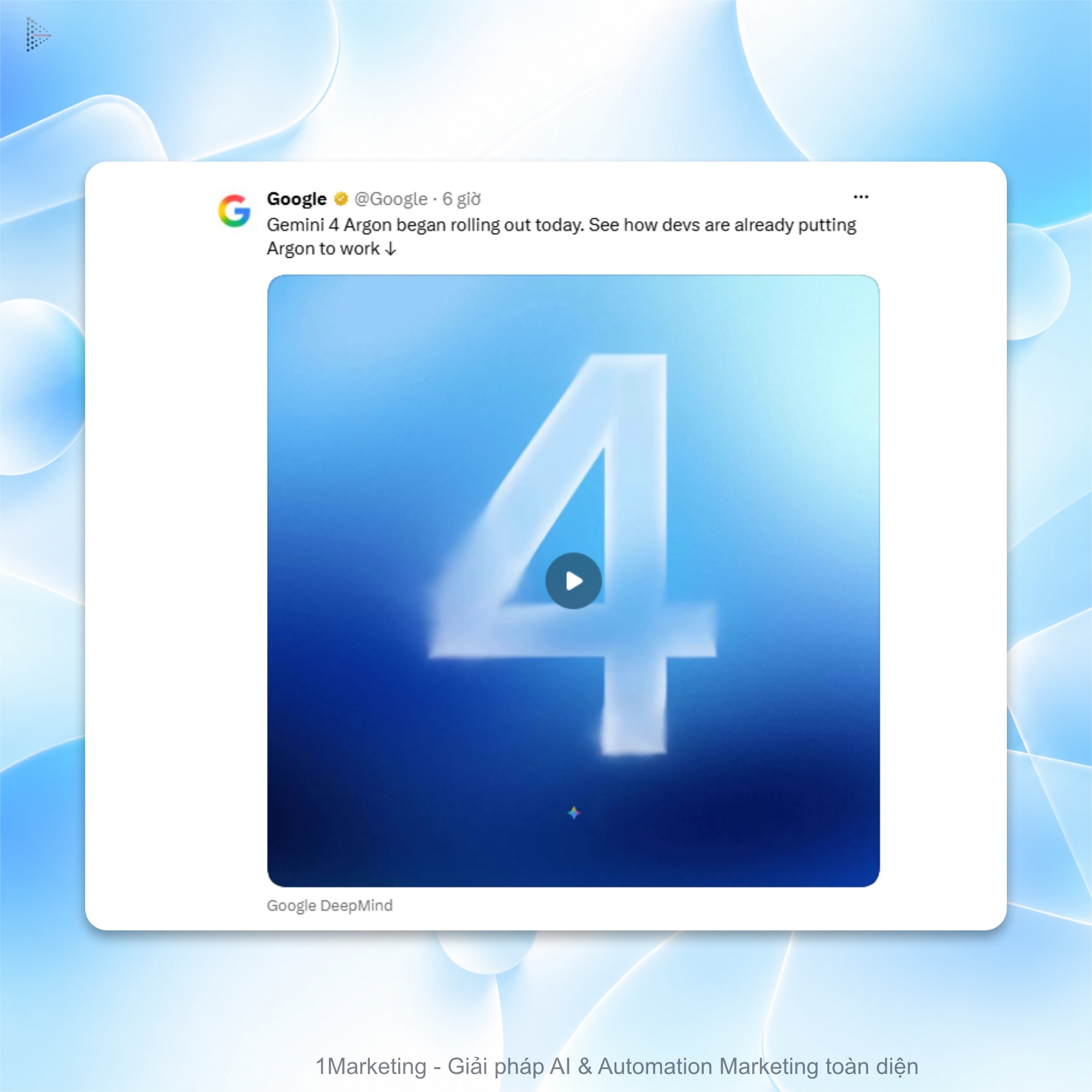
Figure 2: Google's official announcement about deploying Gemini 4 Argon to the global developer community (Image copyright: 1Marketing).
1.2. Origin of the name Argon and mission of the Gemini 4 generation
In the periodic table, Argon (symbol Ar, atomic number 18) is a noble gas with inert properties, extremely stable and non-reactive under normal environmental conditions. Google DeepMind's choice of the designation "Argon" for the pioneering version of the Gemini 4 generation has three core technological implications:
First, absolute stability in the production environment (Production Stability). When deploying autonomous AI agent systems into business practice, the biggest risk is hallucination or reasoning that strays from the business flow. Gemini 4 Argon is designed to maintain a solid state of logical reasoning, minimizing errors when executing multi-day task sequences.
Second, optimize energy and computational latency. Argon represents streamlining in the neural network structure (Model Efficiency), allowing the model to achieve significantly faster response speeds than models of the same parameter scale, thereby drastically reducing API operating costs per query unit.
Third, the beginning of the 4th generation technology cycle. Following the success of the Gemini 1.0, 1.5 and 2.0 series, the Gemini 4 Argon version sets a new standard in the combination of large language modeling (LLM), computer vision and autonomous agent behavior planning.

Figure 3: Multicolored 4-pointed star icon of the Gemini artificial intelligence ecosystem from Google (Image copyright: 1Marketing).
1.3. Breakthrough computing infrastructure and training architecture
Gemini 4 Argon is trained on a new generation supercomputer cluster using Google's Tensor Processing Unit (TPU v5p and TPU v6 Trillium). The training process applies reinforcement learning from verifiable feedback for reasoning models (Reinforcement Learning with Verifiable Rewards), combined with formal verification mechanism (Formal Verification). This helps the model not only guess the next word based on statistical probability, but actually build a Tree of Thoughts to test the correctness of each hypothesis before giving the final result.
2. Groundbreaking Technical Features of Gemini 4 Argon
2.1. Advanced Multimodal Reasoning
Gemini 4 Argon inherits and upgrades the original multimodal architecture right from the pre-training layer. The model can receive and deeply understand the correlation between text, high-quality audio, detailed images, source code, and long-duration video streams.
In particular, in the ERQA (Embodied Reasoning and Question Answering) test measuring the ability to understand 3-dimensional space and realistic physical interaction, Gemini 4 Argon set a new record with a score of 87%. This ability allows AI to recognize distance, acceleration, gravity and collisions between objects, paving the way for applications in smart robots and video analysis of user behavior in retail spaces.
2.2. Massive Context Processing and Long-Form Output Generation (Massive Context & Output)
One of the biggest obstacles of current AI models is the output length limit. When a task requires the AI to write an entire technical document hundreds of pages long or refactor a large software project, the model often breaks down midway.
Gemini 4 Argon completely solves this problem through a dynamic context continuation system (Continuation Engine). The model supports an input context window of up to 1,000,000 tokens and the ability to maintain working memory across thousands of interaction cycles. Thanks to that, businesses can feed entire multi-year transaction histories or entire complex legal documents to AI for analysis without having to chop the data into pieces.
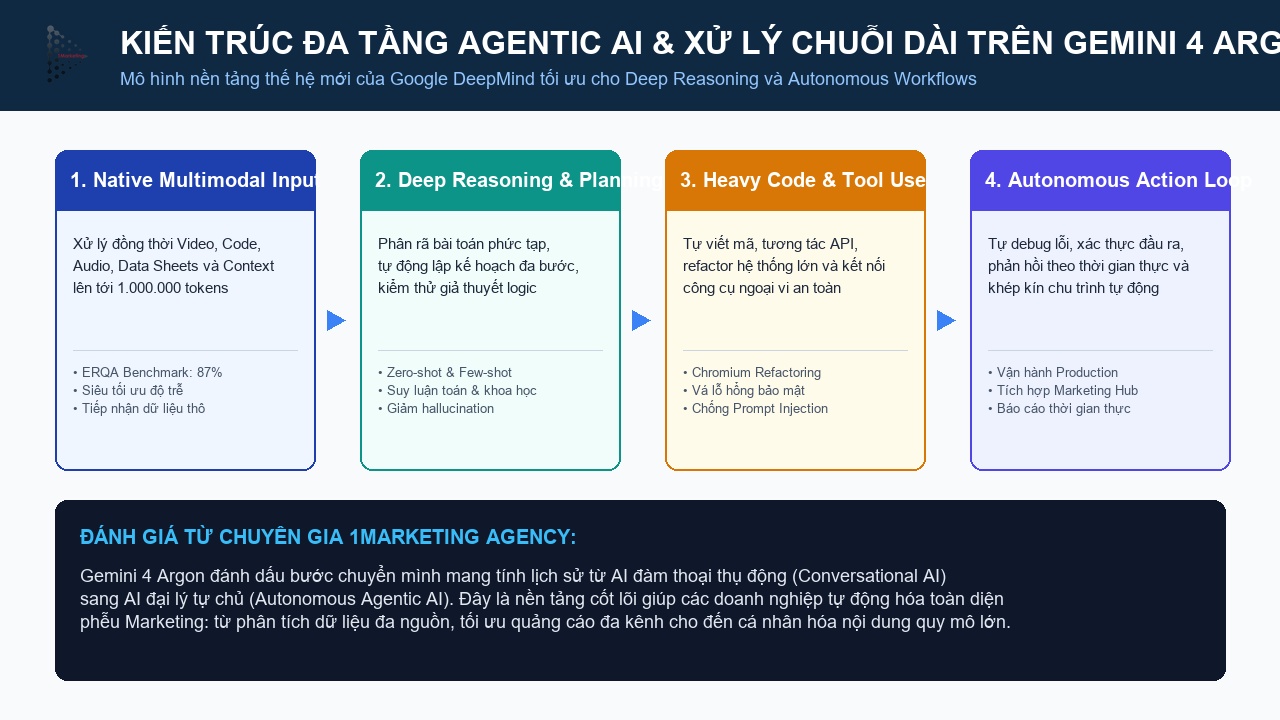
Figure 4: 4-pillar architecture of autonomous task processing and long-chain reasoning of the Gemini 4 Argon model (Image copyright: 1Marketing).
2.3. Programming intelligence and large-scale code refactoring
For software engineering, Gemini 4 Argon goes beyond the role of a conventional code suggestion tool (Code Completion). In practical tests at Google itself, the model participated in handling highly complex architectural refactoring problems on the source code repository of the Chromium browser.
The model is capable of reading and understanding millions of lines of code, analyzing dependency graphs, detecting outdated or unsafe code, and automatically writing unit tests to verify the stability of the entire system after changes.
2.4. Cybersecurity Defense Capabilities and Prompt Injection resistance
Security is always the top barrier that makes businesses hesitate when integrating AI deeply into business systems. With Gemini 4 Argon, Google DeepMind has integrated a proactive cyber defense mechanism (Cyber Defense Core).
The model is trained to identify Social Engineering and Indirect Prompt Injection attacks appearing in unfamiliar document files or websites, and automatically refuses to execute code that has the risk of leaking server data or API access keys.
3. Multi-Dimensional Comparison Table Between Gemini 4 Argon And Today's Leading Models
To provide an objective and accurate perspective for technology experts, the table below compares key specifications between Gemini 4 Argon and its direct competitors in the market:
Technical Criteria | Google Gemini 4 Argon | Google Gemini 1.5 Pro | Anthropic Claude 3.5 Sonnets | OpenAI GPT-4o |
|---|---|---|---|---|
Development unit | Google DeepMind | Google DeepMind | Anthropic | OpenAI |
Architectural nature | Frontier Reasoning Multimodal | Native Multimodal Long-Context | Hybrid Multimodal LLM | Omni Multimodal LLM |
Input context length | 1,000,000 Tokens | 2,000,000 Tokens | 200,000 Tokens | 128,000 Tokens |
Ability to generate continuous output | Up to 1,000,000 Tokens (Continuation) | 8,192 Tokens | 8,192 Tokens | 4,096 Tokens |
ERQA Reasoning Score | 87.0% (Market record) | 64.2% | 61.5% | 62.8% |
Multi-step Agentic capacity | Autonomous | Semi-Autonomous | Semi-automatic (Tool-assisted) | Task support via Function Calling |
Automatically refactor source code | Large source code repository scale (Enterprise) | Function and module level | Module and small project level | Single module level |
Prompt Injection protection mechanism | Active resistance to the architectural layer | Basic safety and keyword filters | Constitutional AI | Moderation API safety filter |
Average response latency | Extremely low (Optimized with Argon Core) | Medium | Short | Short |
Main distribution platform | AI Studio, Vertex AI, Antigravity | AI Studio, Vertex AI | Anthropic Console, AWS Bedrock | OpenAI Platform, Azure AI |
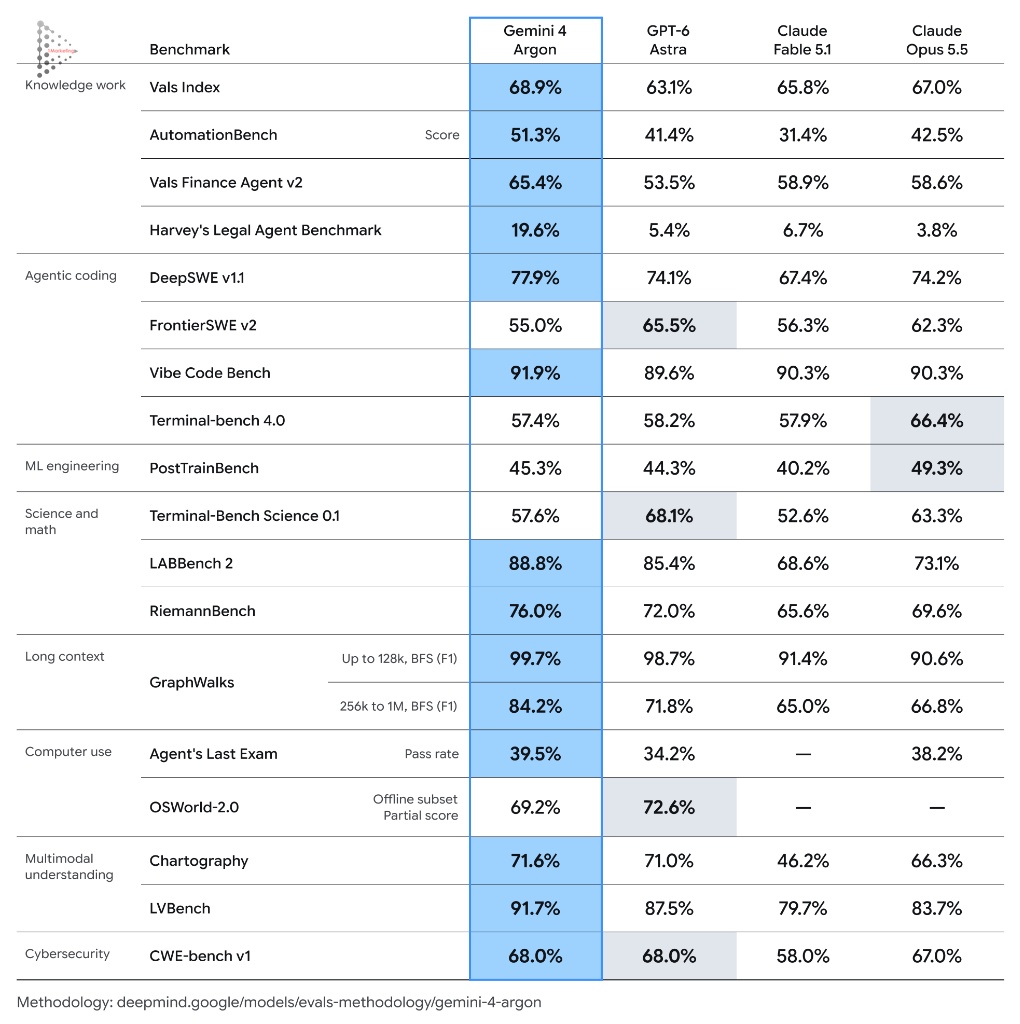
Figure 5: Google DeepMind's official benchmark comparison evaluates Gemini 4 Argon against GPT-6 Astra, Claude Fable 5.1 and Claude Opus 5.5 across core intelligence domains (Image copyright: 1Marketing).
Detailed analysis of in-depth Benchmark results from Google DeepMind
According to the official measurement announcement from the Google DeepMind research department (source: deepmind.google/models/evals-methodology/gemini-4-argon), Gemini 4 Argon demonstrated clear dominance in most of the benchmark evaluations compared to next generation models such as the GPT-6 Astra, Claude Fable 5.1 and Claude Opus 5.5:
Knowledge capacity and work automation (Knowledge work): Gemini 4 Argon leads overwhelmingly on the AutomationBench scale with 51.3% (far exceeding 41.4% of GPT-6 Astra, 31.4% of Claude Fable 5.1 and 42.5% of Claude Opus 5.5). On the Vals Finance Agent v2 financial scale, the model scored 65.4% compared to the average of 53% - 58% of competitors. In particular, in the rigorous legal test Harvey's Legal Agent Benchmark, Gemini 4 Argon set a record of 19.6% (nearly 4 times superior to its closest competitor, Claude Fable 5.1 with 6.7%).
Agent programming: Reached 77.9% on DeepSWE v1.1 and excellently reached 91.9% on Vibe Code Bench, demonstrating the ability to seamlessly convert from natural language to a complete source code structure that can be operated immediately.
Long context window: In the GraphWalks graph tracing test, Gemini 4 Argon achieved an almost absolute 99.7% accuracy at the 128k BFS range and continued to maintain 84.2% performance at the ultra-long range from 256k to 1M BFS, significantly outperforming the GPT-6 Astra's 71.8% and Claude Opus's 66.8% 5.5.
Science, math and cybersecurity: The model scored outstandingly on LABBench 2 (88.8%), RiemannBench (76.0%) and achieved the highest level of cybersecurity defense on the CWE-bench v1 scale (68.0%).
4. Distribution Platforms and How to Access Gemini 4 Argon
Google has deployed Gemini 4 Argon simultaneously through many distribution channels to fully serve target groups from independent developers to large-scale corporations:
Figure 6: Gemini 4 Argon model configuration and testing environment on the Google AI Studio console (Image copyright: 1Marketing).
4.1. Google AI Studio and Google Cloud Vertex AI
For programmers and product development teams, Google AI Studio is the fastest entry point to test Gemini 4 Argon through an intuitive web interface. Programmers can customize parameters such as creation temperature (Temperature), test sample limits (Top-P, Top-K), set system instructions (System Instruction) and integrate function calling tools (Tool Calling).
For large systems requiring enterprise-level data security standards (Enterprise SLA, ISO/IEC 27001), Gemini 4 Argon is fully integrated on Google Cloud Vertex AI with independent data encryption and strict decentralized access control.
4.2. Integrated development environment: Google Antigravity and Android Studio
Google Antigravity and Android Studio are the first development environments (IDEs) to directly integrate the power of Gemini 4 Argon as a Pair Programming Agent. Developers can command AI to automatically error-check entire projects, create cross-platform compatible user interfaces, and write technical documentation automatically.
4.3. Gemini App for Individual and Business Users
General users and business professionals can experience the model's capabilities through subscriptions to Google AI Pro and Google AI Ultra services. This version supports financial document analysis, multi-source market information synthesis and automatic work planning right in the Google Workspace ecosystem (Docs, Sheets, Slides, Drive).
Figure 7: Google Gemini mobile app interface brings next-generation modeling capabilities directly to end users and businesses (Image copyright: 1Marketing).
5. Practical Applications of Gemini 4 Argon in the Marketing Automation Ecosystem
At 1Marketing, as a pioneer in providing comprehensive AI and marketing automation solutions for businesses, we consider Gemini 4 Argon to be a leap forward that will fundamentally change the way the Performance Marketing and Digital Analytics industries operate:
5.1. Building Agentic AI to automatically operate multi-channel advertising campaigns
Previously, advertising management on Facebook Ads, Google Ads and TikTok Ads depended largely on manual operations by media buyers: checking cost per message (CPMess), cost per click (CPC), return on advertising spend (ROAS) and turning on and off campaigns daily.
With Gemini 4 Argon's long-chain reasoning capabilities, businesses can build an Autonomous Media Agent system capable of:
Automatically connect real-time API data from Meta Marketing API, Google Ads API and sales management software (like KiotViet, SAP, HubSpot).
Automatically detect when your ad account is saturated with its audience or has reduced delivery efficiency.
Automatically intelligently reallocate budget from underperforming ad groups to the highest-margin groups.
Independently create A/B Test ad variations across titles, descriptions, and images without constant manual human intervention.
5.2. Automate big data analysis and customer trend forecasting
The huge amount of data collected from websites (Google Analytics 4), CRM systems and message interaction sessions is often fragmented and difficult to fully exploit. Gemini 4 Argon with a context window of 1,000,000 tokens allows synthesizing the entire customer journey over many years into a single analysis session.
The model can detect drop-off points, predict customer groups at risk of leaving the brand (Customer Churn), and automatically suggest highly personalized Re-engagement Campaigns for each customer segment.
5.3. Create personalized content on an industrial scale
Gemini 4 Argon's native multimodal understanding helps elevate digital content production. Instead of creating generic articles or images, the AI system can accurately analyze the brand identity style (Brand Guidelines) and unique preferences of each target customer group to automatically produce hundreds of multi-channel content samples: from social network posts, short video scripts, nurturing email series to in-depth SEO standard articles.
6. 1Marketing's 5-Step Process for Adopting Gemini 4 Argon in Business
To help businesses fully exploit the power of Gemini 4 Argon without the risk of wasting budget or disrupting existing processes, 1Marketing has standardized the implementation process framework of the following 5 practical steps:
Step 1: Survey data infrastructure and identify automation targets
1Marketing's team of experts conducts a comprehensive audit of the business's technical ecosystem, evaluating the quality of customer data sources and the operational flow of the marketing and sales departments. The goal of this step is to accurately identify conversion bottlenecks that can be quickly resolved with Agentic AI to deliver financial results as soon as possible.
Step 2: Design the Agentic AI architecture flow and API integration
Build a detailed system design (System Architecture), establish a connection between Gemini 4 Argon's API with advertising platforms (Google Ads, Facebook Ads), sales management software systems (KiotViet, Haravan, Shopify) and the business's internal data warehouse through automation platforms such as n8n or specialized server systems.
Step 3: Test in the Sandbox environment and control safety risks
Before being put into operation on real assets, the AI Agent system is put into a simulated testing environment (Sandbox). Here, experts will test the accuracy of inference, set safe budget spending limits, review Prompt Injection resistance and absolutely protect the security of internal business data.
Step 4: Production Deployment
Put the AI Agent system into official operation on marketing and sales channels. The model will automatically monitor campaign performance indicators in real time, automatically trigger customer interaction responses, and notify the management team when unusual fluctuations that require approval appear.
Step 5: Monitor, refine inference, and optimize operating costs (CIR/ROAS)
Periodically measure core financial indicators: advertising cost to revenue (CIR), return on advertising cost (ROAS), and API token consumption cost. Our team of experts continuously refines navigation commands (Prompt Engineering) and data filters to maximize conversion performance per dollar of investment.
7. Common Mistakes When Deploying Next-Generation AI and How to Fix Them
During the process of consulting and practical implementation for hundreds of businesses, 1Marketing found that the application of advanced AI models such as Gemini 4 Argon often encountered some systematic mistakes. Below is a summary of typical risks with standardized solutions:
Typical Risks / Mistakes | Real Consequences for Businesses | Standardized Solutions From 1Marketing |
|---|---|---|
Implementing AI as a trend is not tied to business KPIs | Investing in large technology costs but not generating additional revenue or not saving personnel. | Always start by auditing CIR, ROAS and establishing a clear ROI before writing the first line of code. |
Completely dependent on AI without monitoring mechanism (Human-in-the-loop) | AI makes skewed budget spending decisions or customer feedback that doesn't align with brand culture. | Building a safety blocking mechanism (Guardrails): AI automatically analyzes and recommends, decisions that exceed the budget threshold require human approval. |
Inject unnormalized raw data into the model | The inference model is biased due to poor input data quality (Garbage in, Garbage out), causing a useless increase in token costs. | Set up a Data Pipeline, cleaning and rigorously classifying data before loading it into the Gemini 4 Argon context window. |
Ignore the problem of cybersecurity and customer data security | Leaking sensitive internal information, violating legal regulations on personal data protection. | Using enterprise-grade deployment channels (like Vertex AI), establish a policy that does not allow vendors to use customer data to retrain public models. |
Lack of synchronization between the AI system and human resources team | Employees boycott or do not know how to coordinate work with autonomous AI agents, leading to waste of resources. | Organize internal practical training sessions, standardize the coordination process between personnel in charge of operations and the AI Agent system. |
8. Frequently Asked Questions (AIO / GEO Knowledge Snippets)
What is the core difference between Gemini 4 Argon and Gemini 1.5 Pro?
Gemini 4 Argon is the fourth generation launch model designed to focus entirely on long-chain reasoning capabilities (Deep Reasoning) and multi-step autonomy of AI agents (Agentic AI). While Gemini 1.5 Pro mainly plays the role of passive context reception and processing, Gemini 4 Argon is capable of automatically planning, calling tools, self-correcting errors in the source code and maintaining the ability to continuously generate output of up to 1,000,000 tokens.
How can businesses start using Gemini 4 Argon?
Developers and businesses can access Gemini 4 Argon through Google AI Studio by obtaining a personal API key, or deploy on the Google Cloud Vertex AI cloud platform to ensure rigorous security standards. In addition, users can experience the model through the Google AI Ultra subscription package on the Gemini app.
How is the cost of using the Gemini 4 Argon API calculated?
Google applies a flexible fee model based on the volume of input tokens (Input Tokens) and output tokens (Output Tokens). Thanks to Argon Core's optimized structure, the cost per token is significantly streamlined to help businesses easily scale the deployment of automation systems without creating major financial pressure.
Are small and medium enterprises (SMEs) suitable for Gemini 4 Argon?
Yes. Thanks to the ability to automate complex tasks with high accuracy, Gemini 4 Argon helps small and medium-sized businesses possess the same operating capacity as a large corporation with a streamlined human resources system. The most practical applications for SMEs include: automatically caring for and classifying potential customers 24/7, optimizing advertising budgets and automatically generating business financial reports.
Is internal business data safe when sent via the Gemini 4 Argon API?
When using the Gemini 4 Argon API through Google Cloud Vertex AI commercial channels or the Google AI Studio paid enterprise agreement, Google commits not to use customer input or output to train common base models. Data is protected using enterprise standard data-at-rest and data-in-transit encryption protocols.
9. Summary Evaluation and In-Depth AI Transformation Services with 1Marketing
The birth of Gemini 4 Argon from Google DeepMind not only affirms Google's technological leadership position, but also officially opens the era of high-level intelligent automation systems. The transition from the traditional manual operating model to a model supported by autonomous AI agents is no longer a reference option, but has become a prerequisite for determining the competitiveness and survival of businesses in the digital era.
However, advanced technology only truly creates business breakthroughs when placed on a correct strategic foundation, synchronously connected to real data systems and measured by transparent financial indicators. Deploying AI technology on your own in a fragmented manner, lacking professional control, often leads to huge costs but does not bring commensurate revenue value.
In-depth Optimization Solutions from 1Marketing
As the pioneering agency in Vietnam to deeply integrate AI technology into the entire marketing value chain and business operations, 1Marketing accompanies businesses to realize the great potential of new generation models:
Commitment to clear business performance metrics: Every automation solution deployed by 1Marketing is tied to specific commitments on return on advertising spend (ROAS), advertising cost to revenue ratio (CIR) and cost per conversion (CPA).
Free audit of the current system: A team of experts directly reviews and evaluates conversion bottlenecks and automation potential across all digital assets of the business.
Building an exclusive AI Agent system: Design tailor-made AI agents according to the specifics of each industry, automatically manage multi-channel advertising campaigns, connect sales data and take care of customers automatically 24/7.
Real-time transparent financial reporting system: Provides an intuitive dashboard to help business owners and management teams accurately grasp every penny of revenue and expense anytime, anywhere.
Sign up for Free Strategy & Audit Consulting
Businesses that want to upgrade their operating systems and breakthrough sales with leading AI & Automation Marketing solutions, please contact 1Marketing's team of experts immediately to receive an in-depth strategic consulting session and a free system audit program:
Published by: 1Marketing Agency
Official website: https://1m.io.vn/
Professional consulting hotline: 03.6669.6662
Contact email: [email protected]